Erdal Nuhbasa – Law and Consulting Firm – Legal Services

Intellectual Property Rights of the Software Developer and the Client

   In the modern software industry, intellectual property rights are one of the most critical and frequently debated issues for both software developers and employers. When a software developer creates a new application, algorithm, code library, or software product, to whom does the resulting work belong?

   This question creates complex legal situations, particularly in employment relationships. Generally, intellectual property law (copyright, patents, trade secrets, etc.) protects the creator’s work while also allowing employers to claim rights over the outputs produced during the employment relationship.


Who Owns the Code You Write at the Company?

   Article 18/2 of the Law on Intellectual and Artistic Works No. 5846 states: Unless otherwise specified in a private contract between the parties or implied by the nature of the work, the rights to works created by civil servants, staff, and workers while performing their duties are exercised by those who employ or appoint them.

   In other words, at the company, the commercial rights (the rights to sell, use, and monetize) to the code you write as part of your job generally vest in the employer/company. If you want to change this, there must be a clear provision in your contract.

Let’s say you work as a backend developer at a fintech company. You developed a payment system for the company during work hours. You cannot later leave the job and say, “I wrote this code, so now I’ll sell it to another company.” Yes, you wrote the code, but since you did so as part of your job, the economic rights belong to the company. You remain the author of the work, but you do not have the right to sell the code.

   The employer is free to use the software as they see fit, exercising economic rights such as reproduction, distribution, and developing new projects. Moral rights—such as the right to be credited, the right to public disclosure, and the right to preserve the integrity of the work—remain with the developer under all circumstances and cannot be transferred.

   Legally, the employer cannot exercise the author’s moral rights in their own name. For example, if an application is written by an employee and delivered to the employer, the employer may only publish that application under the employee-developer’s name. Otherwise, the author’s moral rights would be infringed.


 

What’s the situation when you take on freelance or external projects?

   If the employee is not subject to an employment contract (Turkish Civil Code, Art. 470), the situation is different. In an exception contract entered into with an independent developer (freelancer or consultant)—rather than with a full-time employee—Article 18/2 of the Copyright Law does not automatically apply. In other words, if a software company enters into an agreement with an independent developer who is not its employee, the economic rights to the resulting code do not automatically transfer to the company. 

   In this case, the developer remains the copyright owner, and the employer must sign a license or rights assignment agreement to use the code. Otherwise, even if payment has been made, using the developer’s software is unlawful. This is because it is not the transfer of funds but this agreement that determines the owner of the work.


Is it legal to use open-source code and make money from it?

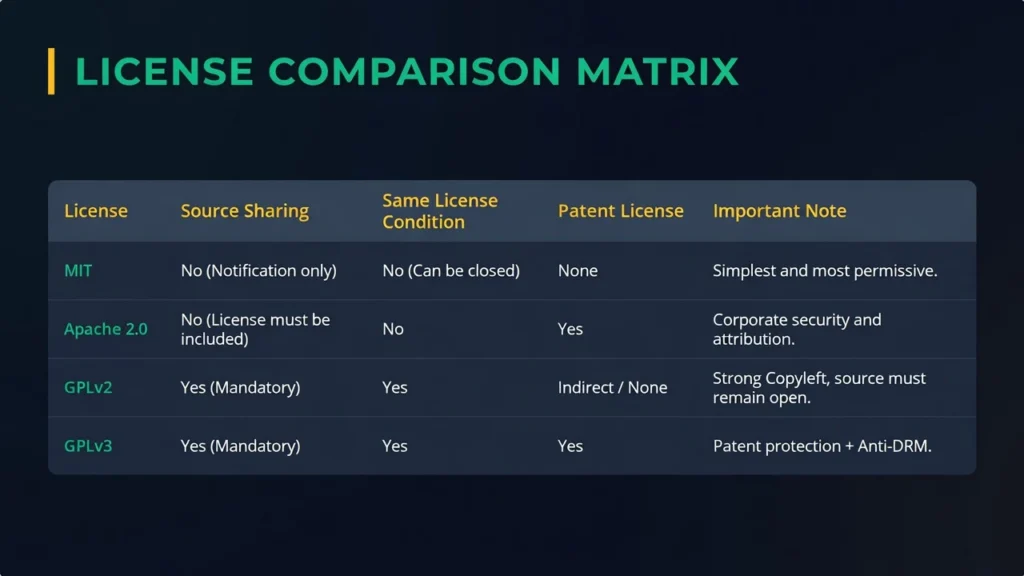
  Open source does not necessarily mean “completely free.” Some open-source licenses are very permissive (use it however you like), while others state, “If you include this in your commercial product, you must also make the source code for your entire product available.” This is called “copyleft.” Let’s explain this based on the different types of licenses:;

  •   MIT License: It allows for any use, modification, and distribution of the code, with the sole condition being that the copyright notice is preserved. For example, suppose you wrote a library and released it under the MIT license. A company takes it and incorporates it into its own closed-source, paid application. As long as the company includes a small copyright notice in your application stating, “This library belongs to [name],” it can sell its application for millions of lira without showing anyone the rest of the application.
  •   Apache 2.0 License: It is permissive but includes some additional obligations. You must include a copy of the license with each distribution, notify others of any changes made, and preserve the copyright and patent notices. In other words, if you used code licensed under the Apache 2.0 License and made improvements to it, you can still keep your application proprietary; however, if you made a change to the original Apache code, you must state this by saying, “I made a change to this file, which is licensed under the Apache License.” Additionally, no one can sue you for using this code by claiming, “This code infringes on my patent.”
  •   GPLv2 (GNU GPL 2.0): It is a strong copyleft license. If you share your code under the GPLv2, any software derived from yours must also remain under the GPLv2. Any modifications or derivative works are also subject to the GPL terms. When distributing the software, you must provide the source code or, at the very least, a reference where the code can be obtained. For example, suppose you modified a GPLv2-licensed piece of software, embedded it into a device, and began selling that device. You are required to provide the customer who purchases the device with the source code for the software inside the device (including the changes you made). You cannot keep your code “secret” and sell it; if you do, you must make your entire product open source under the GPLv2.
  •   GPLv3 (GNU GPL 3.0): It is a modernized version of GPLv2. The concept of copyleft remains the same; it also includes anti-TiVoization (prohibiting restrictions on devices that prevent users from modifying the software) and patent protection. In projects distributed under GPLv3, it is mandatory to share the source code of any modifications and to release derivatives under the same license. So, let’s say you built a media player using GPLv3-licensed code. You must provide the source code to the user. Furthermore, you cannot impose a restriction on your device stating, “This code only works on my hardware; others cannot modify it” (anti-DRM). If you do so, you will lose the patent protection provided by GPLv3.

Is Reverse Engineering and Code Review Illegal?

   Reverse engineering—that is, analyzing how a piece of software works and deciphering its code to create a similar program that performs the same function—is generally considered a violation of intellectual property law. However, in Turkey, the Law on Intellectual and Artistic Works (FSEK) exempts reverse engineering under certain conditions. Pursuant to Article 38/2 of the Law on Intellectual and Artistic Works, a person who has lawfully obtained software may examine the program to understand its concepts and principles and may obtain the necessary code information to make it compatible with other software. This grants the user the freedom to observe how the code operates while running the program.

   For example, if a company has obtained an unregistered copy of software written for a client, it may analyze only the lines of code necessary for compatibility. However, the scope of this exception is limited: The information obtained must be used solely for compatibility purposes and may not be used to develop new software or to plagiarize the work.

   In practice, many software licenses contain provisions stating that “reverse engineering is prohibited.” In Turkey, the compliance exception applies. If significant reverse engineering is performed on confidential source code, this may constitute unfair competition and a breach of trade secrets. Therefore, while the code may be examined for compliance purposes when necessary, digital evidence (logs, emails) of these analyses must be retained.

What Should I Do If My Project Is Stolen?

   In Turkey, there are various legal remedies available against those who attempt to steal or use your software without permission. In the event of copyright infringement, the copyright owner may seek injunctive relief and damages in accordance with the provisions of the Law on Intellectual and Artistic Works. For example, Article 70(2) of the Law on Intellectual and Artistic Works (FSEK) stipulates that in cases of unauthorized use, the copyright owner may be compensated for economic losses and unjust enrichment through legally appropriate damages.

   In addition, unauthorized copies in print or digital formats may be seized. Under Articles 70 and 68(1) of the Law on Intellectual and Artistic Works, damages of up to 1–3 times the license fee determined for the identified infringement may be sought. If the infringement is not ceased upon the rights holder’s request, the rights holder may file a criminal complaint to initiate criminal proceedings; copyright infringement is classified as a criminal offense under Article 71 et seq. of the FSEK. Claims for breach of trade secrets or business secrets may also be pursued under the Turkish Commercial Code and the Unfair Competition Law.


For More Question

Contact Now!
Other Articles
What Are the Intellectual Property Rights of the Software Developer and the Client?
What Are the Intellectual Property Rights of Software Developers and Clients? Key Considerations Regarding Software Copyright and Employment Contracts...
Turkish Citizenship After 5 Years of Residence in Turkey (2026)
How can you obtain Turkish citizenship by residing in Turkey for 5 years without interruption? Updated requirements for 2026, required documents, types of residence permits, rules regarding...
How to Bring Pet to Turkey 2026 Pet Import Guide
Planning to bring your pet to Turkey? Learn the requirements including microchip rules, rabies vaccination, titer test, airline regulations and procedures...
Entry Ban to Turkey: How to Revoke Entry Ban
If you have an entry ban to Turkey, you can learn the reason and then appeal the ban decision for revoking the entry ban decision...
“Closed Neighborhood” Restrictions in Istanbul Have Been Lifted! (2026 Update)
The "closed neighborhood" rule for foreigners in Istanbul has been lifted as of June 10, 2026. Learn about the new residence permit application process here...
2026 Residence Permit Costs and Fees in Turkey
Updated 2026 residence permit fees in Türkiye. Detailed explanation of residence card fee, residence tax, exemptions and payment process...
How to Appeal the Cancellation of Your Turkish Citizenship
Did you receive a notice about your Turkish citizenship being canceled? Don't worry. Learn how to appeal and restore your status...
Bringing Foreign Car to Turkey: Conditions and Customs Procedures (2026)
Learn the legal requirements for bringing foreign-plated car to Turkey, including the 185-day rule, 730-day limit and customs procedures...
Turkey Customs Guide 2026: Cash and Gold Limits
Can you bring unlimited gold or cash by paying tax? Avoid costly mistakes—learn the 2026 customs limits and commercial entry rules before you travel...
How to Pay the Residence Permit Fee?
A step-by-step guide to easily paying your residence permit fee online in Turkey. Which banks and payment methods are available?...
Amnesty for Illegal Foreigners in Turkey, How to Apply?
An amnesty has been introduced in Turkey for illegal foreigners who want to work in domestic services. As of March 2025, Ministry of Interior will allow individuals who cannot schedule an appointment...
YÖK Diploma Equivalency for International Students: How to Apply (2026)
How International Students Can Get a YÖK Diploma Equivalency Certificate in 2026 – Step-by-Step Guide with Required Documents and Online Application...
Family Residence Permit in Turkey – 2026 Comprehensive Guide
Get your Turkey Family Residence Permit: eligibility, fees, documents, duration, and step-by-step guide to live with your spouse and children...
Restriction Codes in Turkey and How to Appeal Them?
When you have an entry ban you will get a restriction code which describes the reason of the ban. Which ban code is given for which case?...