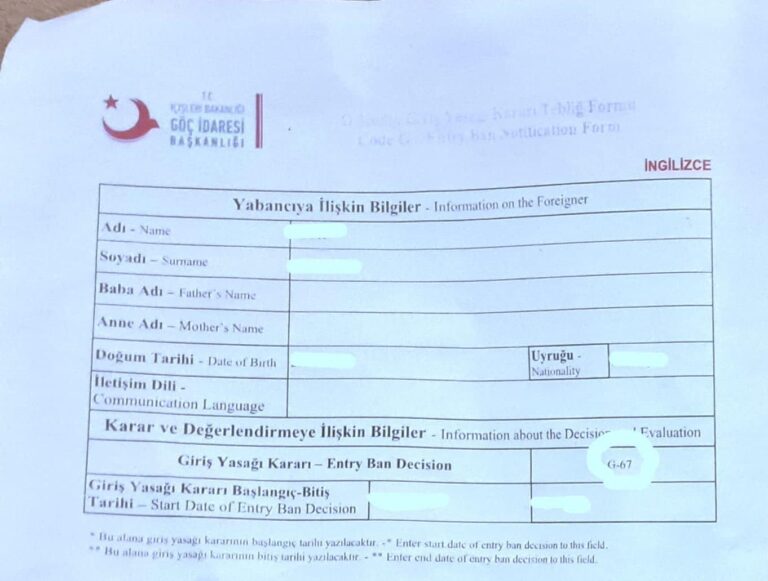
An Entry Ban Code is issued to individuals who have been banned from entering Turkey, and the code is usually specified on the Entry Ban Notification Form. The restriction code must be notified to the foreign national when they leave the country or when they wish to enter the country. However, in practice, an INAD Passenger Form is mostly issued, and this form states, “This passenger is not allowed to enter Turkey under the Law on Foreigners and International Protection numbered 6458 for the following reasons.” 6458 is not an Entry Ban Code, it is the law number.
To inquire about the Entry Ban Code, you must apply to the Directorate of Migration Management. Since you have an entry ban, you can only make this application through a lawyer. Do not trust people on the internet who ask you for money and say they can check your Entry Ban Code; you can only learn the correct information through the lawyer to whom you have given power of attorney.
Individuals banned from entering Turkey can see the reason for the ban on the Entry Ban Notification Form given to them. However, if you are trying to enter Turkey from abroad and are not allowed entry because you have a ban decision, sometimes an INAD Passenger Form is given instead of this form. It is not possible to see the Entry Ban Code or the detailed reason for the ban on the INAD Passenger Form. Only the law on which the ban is based is specified. You can read my article below for what you need to do to learn the detailed reason for your ban.
https://erdalnuhbasa.com/ban-on-entry-into-turkey-a-guidebook-for-how-to-revoke/
If your entry to Turkey has been banned, you definitely have a Entry Ban Code. If you know the Restriction Code exactly, you can understand the general reason for the ban. However, it is not possible to learn the exact reason and the supporting documents that caused the ban without filing a lawsuit. Restriction Codes consist of one letter and one number. You can see the Restriction Code in the Entry Ban Decision section of the ban decision notification form shown in the picture. In this example picture, the Restriction Code for the foreigner is G-67. Additionally, the most common entry ban codes given are Ç-101, Ç-102, Ç-103, Ç-104, Ç-105, Ç-184 N-99, O-100, V-68, V-84, V-87, V-164.

It will be easier for you to appeal your ban order once you know the code that caused the ban order and the event that caused the code to be issued. The most important thing to remember is that you must appeal against the ban order within a total of 60 days after you are notified of the ban order. If you miss this period or if your appeal is rejected, the ban will be finalized.
Once the ban is finalized, your only way to enter Turkey will be to obtain a special visa called Özel Meşruhatlı visa. In order to obtain this special visa, you must have a valid and important excuse (health, education, family, etc.). Otherwise, you will not be able to enter the country for the duration of the ban.

A restriction code or entry ban code is assigned to foreigners who are prohibited from entering Turkey for a specific period, based on the Circular No. 2024/5 on the Implementation of Entry Bans and Pre-Approval Decisions dated 01/11/2024. This code is recorded in the individual’s file, and the person is barred from entering the country for the specified duration.
Foreigners who come to Turkey for various purposes but fail to comply with the country’s laws—by committing administrative or criminal offenses, threatening public safety or health, or violating visa rules—may be assigned a restriction code or pre-approval decision. Each code consists of one letter and one number and has a specific meaning. It indicates whether the foreigner has been deported or denied entry into Turkey.
If you believe a entry ban code has been assigned to you by mistake, you may request its removal through objection or legal action. Please note that in Turkey, only Turkish lawyers are authorized to handle such cases.
Data entries for “Ç” codes are carried out by the Directorate General, provincial directorates, or border gate personnel. For foreigners who have a deportation order and are escorted to the border gates for departure, the “Ç” code data entries are performed by the provincial directorates.
On the other hand:
the “Ç” code data entries are carried out by the border gate personnel.
This restriction codes are generally given after visa violations, illegal entries or work permit violations.
Foreigners with a “G” entry ban code are not allowed to enter Turkey and are classified as inadmissible passengers at border gates. Notifications regarding the ban are issued by the relevant authorities or provincial governorates and submitted to the Directorate General monthly.
If the person is determined to be a Turkish citizen, the ban is lifted according to the Constitution. In certain cases, the Directorate General may temporarily lift the “G” code, allowing entry under written instructions sent to the relevant border gate.
Blue card holders who renounced Turkish citizenship may also face a “G” code ban for reasons of national security, public order, or public safety. Any discrepancies in the identity information of a foreigner with a “G” code are updated by submitting the relevant documents to the Directorate General..
K restriction codes are codes for foreigners who are wanted on suspicion of having committed a smuggling offense. K stands for Kaçakçılık in Turkish which means Smuggling in English.
Interpol has issued a Blue Notice. M stands for Mavi in Turkish which means Blue in English. Blue notice is requested about a person in connection with a criminal matter to gather more information. Just like G-67, there is M-67 code for fraud crimes. When it is with M, you should know that it is about the Blue Notice.
N restriction codes are codes that indicate that you need to get permission before going to Turkey. The authority to obtain permission is the Directorate of Migration Management. If you have this code and apply for an entry permit from the Directorate of Migration Management to enter Turkey and are rejected, you will be subject to an indefinite entry ban.
There are different types of N codes;
O Restriction codes are related to the International Protection Procedure. In particular, they are set in cases where applications for International protection have been rejected or withdrawn by the applicant. A code given when an application for international protection is withdrawn by the applicant or evaluated negatively by the immigration authorities.
Turkey’s “V” restriction codes are a group of administrative markers applied to foreign nationals—mostly related to visa and residence permit issues—that can result in an entry ban or other restrictions on re‐entry. In essence, when a V code is imposed, it reflects a problem or irregularity with a person’s immigration status.
V restriction codes are;
Y restriction codes are restrictions created by Interpol for individuals for whom a Green Notice has been issued. Y stands for Yeşil in Turkish shich means Green in English.
The green notice is used to monitor and track individuals who are suspected of committing crimes at the international level or who are criminals. The notice is issued in order to inform Interpol member states about the person in question and to gather additional information about him/her, if necessary. These codes contribute to crime prevention and international cooperation by controlling the cross-border movement of persons.
Foreigners will not face an entry ban in Turkey if the violation period is less than 3 months and any administrative fines have been paid:
Conditional entry is entry made by obtaining a Special Visa. (Özel Meşruhatlı Vize). The foreigner commits to applying for a residence permit after entering Turkey, and entry permission is granted to them. Therefore, despite the entry ban to Turkey, it is possible to enter the country in special circumstances. It is important to report your special or exceptional circumstances to the Consulate accurately and effectively.
There is a special rule for “conditional entry” into Turkey (those who enter by promising to apply for a residence permit in Turkey): Apply for a residence permit within 10 days of conditional entry. If foreigners do not apply for a residence permit or leave the country before the 10 days are up without waiting for the result of their application, even if they pay the fine, they will be issued a Ç-101 code for failing to fulfill their conditional entry obligation, and their entry into Turkey will be prohibited for 3 months.
There are individuals who cannot be issued an entry ban to Turkey. Neither a restriction code nor a prior authorization decision can be issued for these individuals. Individuals who cannot be issued an entry ban or prior authorization decision are as follows:
When you want to enter Turkey, If you are not allowed to enter at the airport or at the border gates and you are told that there is an entry ban, first of all, do not panic. This can be by mistake or some misunderstanding with the documents. Even it is not, still there is no need to worry about something.
You will be given the relevant ban decision or the inadmissible passenger form (INAD) and your return ticket will be arranged. Do not offer money to the police or other officials who are with you in this situation. Likewise, do not believe anyone who asks for money, saying that they will help you.
If you are notified of a ban, you will be able to find out what the ban is about by looking at the code on the ban. If you have been given an INAD form, it will only contain the code of law on which the ban is based. Therefore, you will not be able to understand the reason for the ban. What you should do in this case is to contact with a lawyer to go to the immigration office and ask for the reason of the entry the ban. After learning the reason If you think that the reason is not related to you, you can appeal the ban decision.



Contact me for further assistance on this matter.
Contact Now!